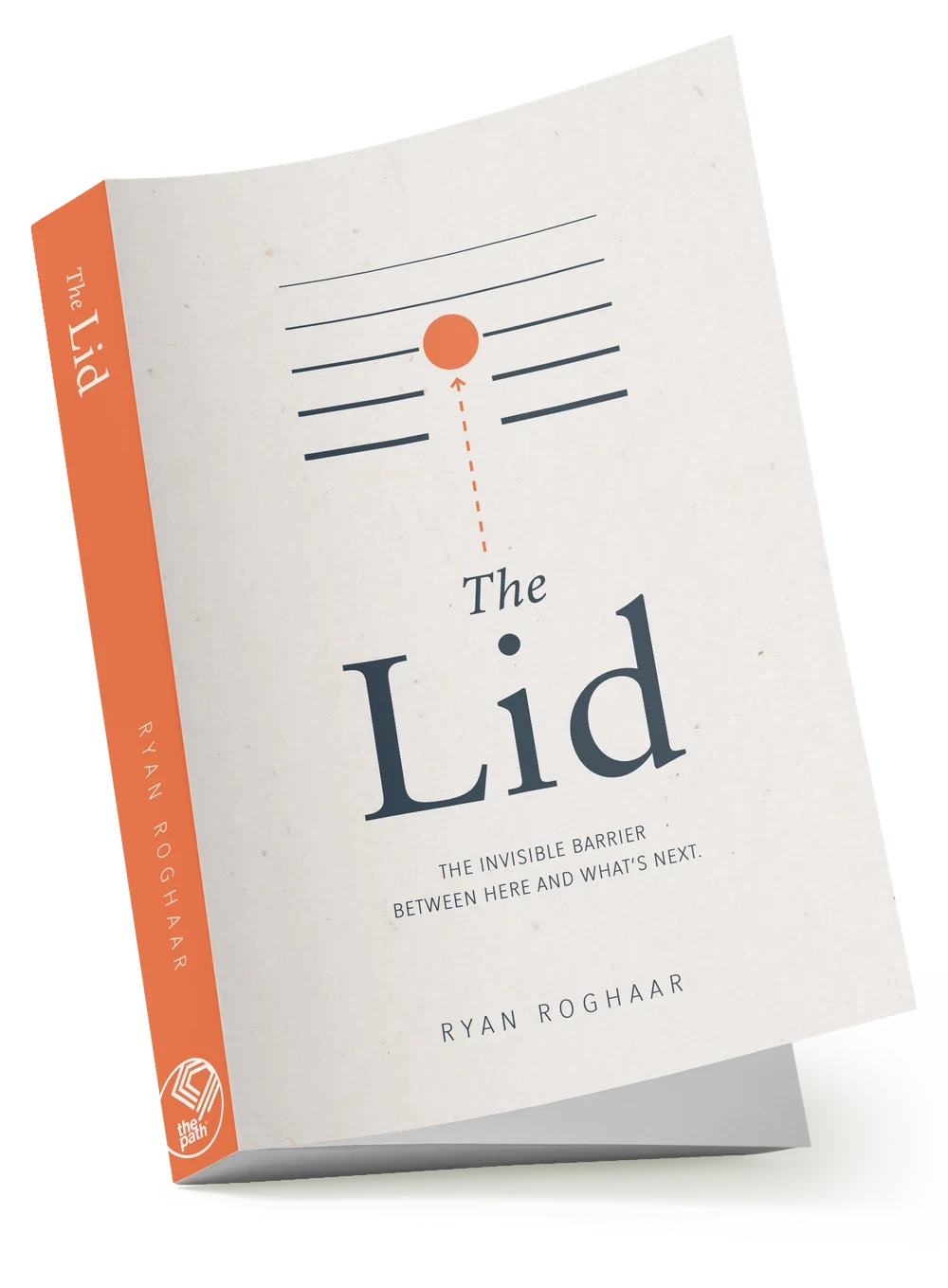
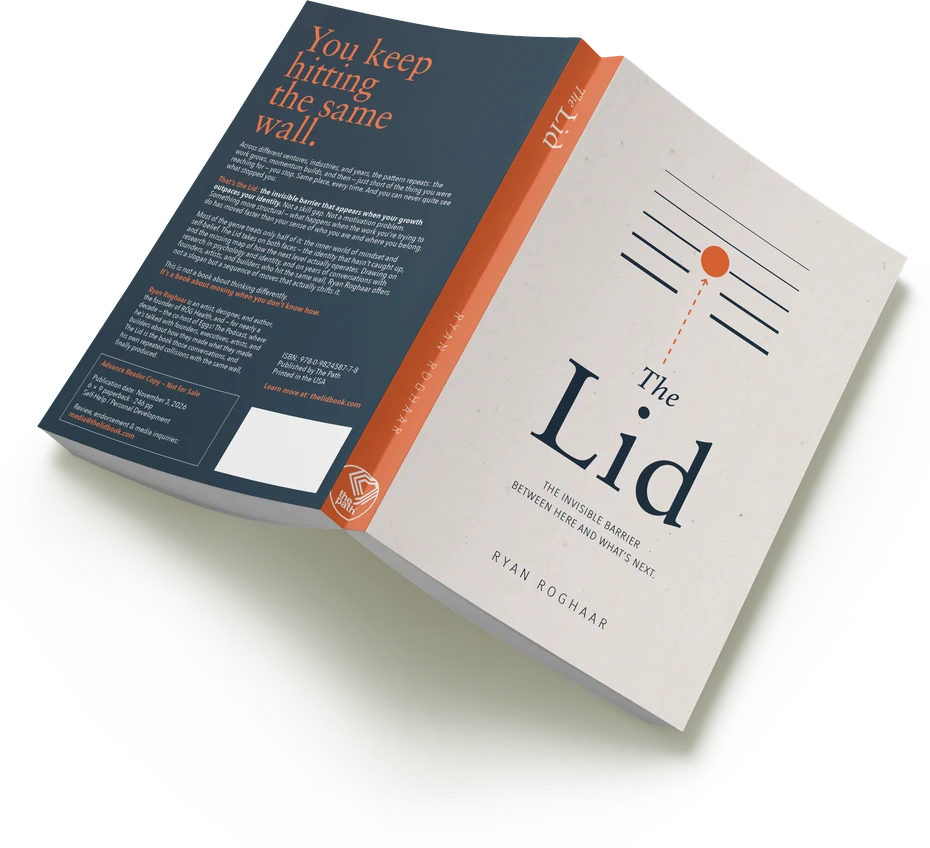
It looks like a skill gap. That's why the advice
never works.
The Lid is the invisible barrier that appears when your growth outpaces your identity.
It disguises itself as a skill gap and as a motivation problem, which is why the usual advice keeps sliding off it. What's actually happening is that the work you're trying to do has moved faster than your sense of who you are and where you belong.
Most of this genre treats only half of the problem — the inner world of mindset and self-belief. This book takes on both faces: the identity that hasn't caught up, and the missing map of how the next level actually operates.
This is not a book about thinking differently. It's a book about moving when you don't know how.
Every Lid contains
the same five elements
What changes from one Lid to the next is the proportions.
The two faces — the shape of it
The internal face
Identity, self-concept, and the accumulated sense of what belongs to you and what doesn't.
The external face
Structure. Missing information, missing exposure, no working model for how the next level actually runs.
The three forces — what holds it in place
The Threshold Loop
The six-step cycle the Lid maintains itself with: you approach the move, a story arrives explaining why now isn't the time, the action stalls, productive-feeling work shows up in its place, the substitution gets framed as progress, and you return to the level you started at.
The Social Lid
The way the people who've known you longest reflect an older version of you back — and the way the rooms you spend time in are calibrated a level below what you're reaching for. Rarely intentional. Often loving. Drag regardless.
The Fog
The limit of your ability to picture, in concrete detail, what life at the next level actually looks like. Not information you're missing — experience you haven't had. The Fog thins through proximity.
What's in the book
Four parts, thirteen chapters, and a tools section you'll use more than once.
It draws on research in psychology and identity — self-discrepancy, possible selves, self-efficacy, self-verification, implementation intentions — alongside eighteen long-form interviews with founders, artists, and builders who hit the same wall, drawn from nearly five hundred conversations recorded for Eggs! The Podcast.
Part One —
The Shape of the Thing
What the Lid is, and the distinction the rest of the book runs on: the internal face, built out of identity, and the external one, built out of structure.
Part Two —
How It Gets Built
Where the barrier comes from in the first place, and why it follows you across careers, companies, and decades rather than staying behind with the situation that produced it.
Part Three —
Why It Stays
The three forces that keep it in place once it's there: the cycle it runs on, the people who reflect an older you back, and the future you can't picture.
Part Four —
The Crossing
The method. Diagnosing accurately, making the other side concrete enough to pull, getting physically near the operation, and the first move that makes the old story hard to keep telling.
Free sample
Read chapter one
The whole first chapter as a PDF — what the Lid is, the two faces it wears, and the research underneath it. It stands on its own.
About Ryan Roghaar

Ryan Roghaar is the founder of RŌG Health, a commercial readiness and decision-support firm for medtech and medical device companies. He has spent two decades on the problem of how organizations translate what they've built into something the market will actually buy. He is the co-host of Eggs! The Podcast, a long-form interview show spanning nearly 500 episodes, and the publisher of The Path, a weekly business newsletter where the four essays this book grew from first appeared.
He lives in Salt Lake City with his wife and their two sons.
Get the book
The book is out November 3
Paperback and Kindle on Amazon. Want to know the moment it's live? Leave your email and I'll tell you.
Want to read some of it first? Chapter one is free.